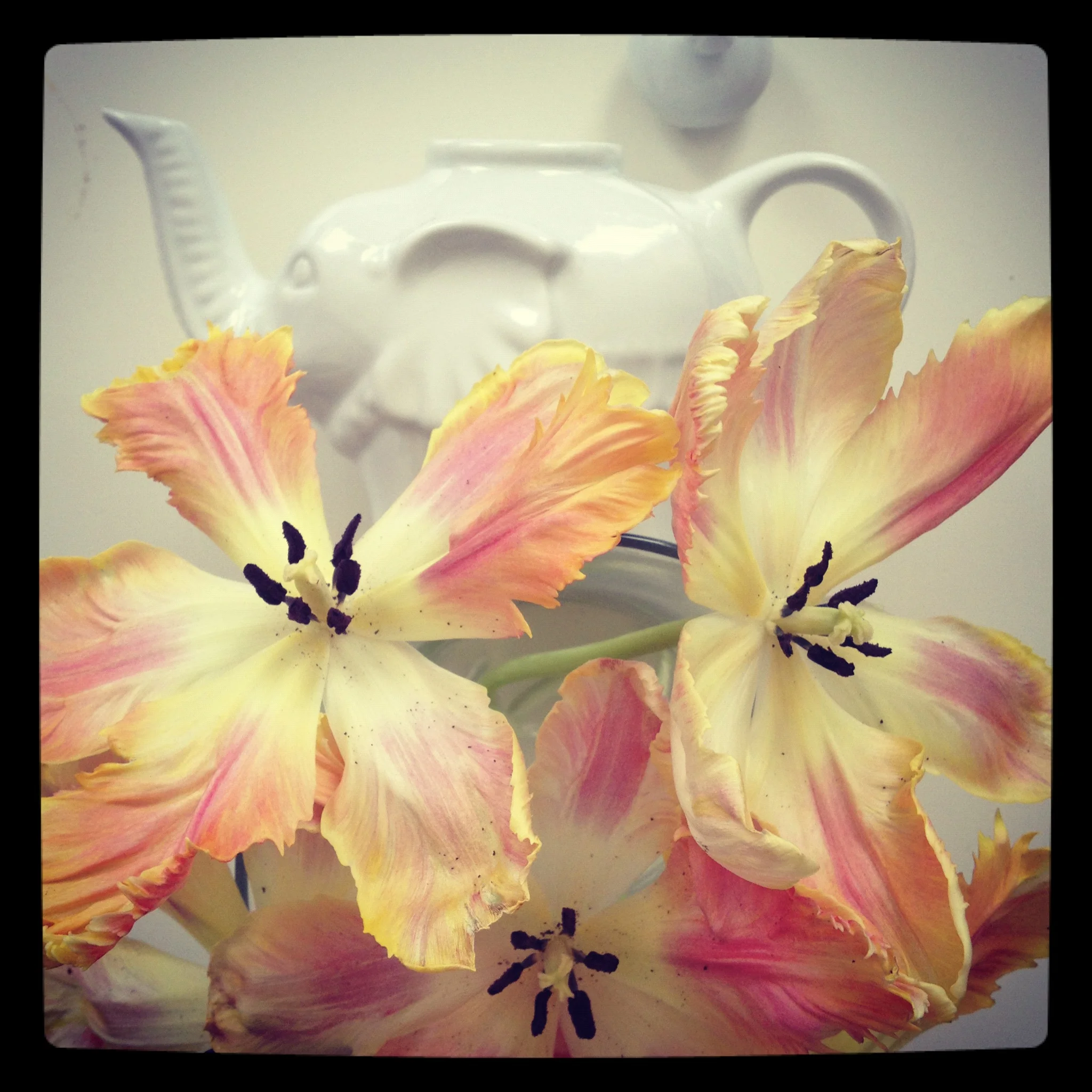
It is past midnight and Troy, Marcelo, Oscar and I are in the living room drinking wine around a candlelight as we wait for the electrician to come and fix our electricity. Troy and Marcelo are making our Thanksgiving plans and describing deep-fried turkey and green-bean casserole. Do you like okra? What about collards? "How do I write collard greens?", I asked Troy. "If you are quoting me, you can say I said 'collards', that's what we call them." In the meantime, the electrician has come with the bad news that it is not a fuse problem but a failure in the whole wiring system, which means we won't have electricity tonight, or not even tomorrow. We could all sleep in the living room. Camping in.

. . .
"I like your blog", Josefa exclaimed to my surprise over brunch yesterday. I don't consider myself a writer or an artist, but knowing that what I write connects with others' experience gives it a greater meaning. We had a long conversation about life-changing decisions, love and work from a gender perspective. "I think it is our responsibility to show a new role model for the women coming behind us, the new generations", she said. "Some people say you can't have it all: work and a family," she continued. "Why not?" I interrupted without knowing the answer. Yesterday was Josefa's birthday and she felt like walking around Soho before meeting with friends to let the hours go by as we drank bottles of prosecco at a bar in the West Village.
. . .
"What date is today?" Troy asked, "it is my New York anniversary; I've been here for 14 years." We all sigh to the idea of time passing by so fast. "I reckon I'll be here for a 'coon's age'", Troy says with a Southern accent that rarely shows.

Yellow Flowers

I've been always fascinated by how life and beauty blooms even in the most harsh circumstances. It is in a way a certain kind of resilience, a genuine manifestation of adaptation and survival. In Mexico City, even as polluted and populated as it is, you'll always find yellow flowers blooming in between the concrete blocks on the sidewalks. In the same way, you'll always meet people that have managed to find joy in what appears to be hostile routines. "I love cinema, artistic films and reading science fiction," a taxi driver told me as he drove me from Condesa to Polanco in Mexico City, "I read during traffic lights, and take advantage of the long hours I spend stuck in traffic". Ten years ago my mother, grandmother and me made a road trip in search of our roots in Jalisco. We drove to Platanar, a small village two hours away from Guadalajara that came into oblivion when a highway was built destroying its plantations and making it impossible for drivers to drive through it; or even know of its existence. Manuel, my grandmother's cousin, still lived there and took care of his parents, who must have been almost a hundred years old. They lived in a house in ruins, most of the ceilings where long gone, and the interior patio of a once colonial house was covered with fallen walls, bricks, oxidized pieces of metal and long-stem wild grass. I was surprised to find out that Manuel appeared content with his life, and even more so to discover that he could easily talk about black holes, fractals or bio-technology. Everything he had done all his life was to read every single publication that made its way to Platanar; this included years of volumes of Selection of Reader's Digest. Nobel Prize writer Wole Soyinka spent 27 months in jail before fleeing his native Nigeria to the United States. He was denied access to books, paper and ink so he tried to remember every possible mathematic equation to keep his mind alive. These stories remind me of one of my favorite movie scenes from The Diving Bell and the Butterfly: I survived because I held to my own humanity. That's all I could do because that is all I had. Like you. Cling to your own humanity and you'll survive. Like yellow flowers blooming from concrete blocks.

I've been thinking to create a group to invite everyone that had suffered a panic attack at least once in their life. Even when I've had them in the past, I always forget how terrifying they can be. Last week, after a delightful brunch with Lily at Cornelia Street Cafe, I wondered around the West Village by myself. It seemed perfect at first, nice weather and all the time of the world for myself to roam around. Suddenly, and without any anticipation, everything felt wrong, somehow off. The weather was not as nice as I thought, it was actually extremely hot and humid, and the time for myself felt like an endless and empty agenda. Rapid heart-beats and sudden panic followed by sweaty hands and trembling feet. It was not the first, but the third time in my life it happened, so I reacted promptly haling a cab and getting home - to a safe space - as soon as possible. The next day I signed in for therapy. Somewhere I read that panic attacks are one of the most terrifying experiences; with no doubt it is for me. My therapist says it is a good sign that my body is reacting and calling for attention. "This in New York City, and it is stressful to be in this city. If you add your travels, your long-distance relationship and your perceived lack of stability, it is natural for your body to react in such a way." I've been talking and sharing about it with friends, and I've been happily surprised by their response. Maaike has sent a podcast of her favorite meditation teacher. Daniel and Capuchi have spent their Sundays with me. Victor has called every morning with special eagerness. Others have shared their own anxiety experiences. "If anyone has an intestine infection they'll run to the hospital and get treatment, but must people wouldn't ask for help if they feel anxious," Daniel says, "mental health is terribly stimagatized." As my therapist recommended, I've been spending time with myself every morning to establish a routine I can carry with me with every travel. For the past days I've been drinking chai tea with extra cardamom while reading the newspaper by the window. Being good to oneself sounds like an easy task, but for some of us it takes all of our mindfulness to do so.

I love myself in this picture as it reminds me of my inner strength. Looking straightforwardly at the camera, so secure of myself, my elbows resting on the car and with the expression of someone that has lots of ideas to share and is confident on who she is; feeling beautiful with being messy.

My father died when I was 3, so as a girl I took the grief as an opportunity to reinvent who he was. He became my hero, representing what I wanted as a role-model for me, what I wanted to inherit from him. I always pictured him as a strong, confident yet loving person. A kind leader that is loved for he gives himself openly. Brave, defiant and outspoken. I imagined him walking and standing by me, whispering that I should be strong too, being proud of who I was and letting me know that everything, always, would be alright. I don't know how old I was when this picture was taken, but he is definitely standing by me.

Notes on redemption, ambiguity and archetypes

“We all can relate to a redemption story”, Troy said at brunch a few weeks ago. His comment sank in as I was just reading a piece on the use of archetypes and ambiguity in storytelling as a way to appeal to a greater audience. Stories of redemption are indeed part of our collective memory, even when the redeemer, the need for redemption and its process are contextual. I read in a book review in the Financial Times that there are universally shared truths that are arrived at differently in many systems of thought. If our choice of our own truth is at all meaningful, we must experience other truths as truthful.

In my search for a new and expanded set of meanings, I went to an event that brought together a Buddhist and a Rabbi to discuss The Tibetan Book of the Dead. “The Book of the Dead describes two central archetypes, one representing the positive and the other representing the negative. It is us with our accumulation of experiences that we interpret what the archetypes stand for. Everything we say about God comes from our perception”, the Buddhist said, “Jesus represents the universal story of redemption.” For the Buddhist, there are five aggregates of self: form, sensation, perception, interpretation and consciousness. “I don’t even know what self, or for that matter soul, means”, the Rabbi joked, “for me it is about being alive or dead; you are your body so when the spark of life in it dies, everything you are goes with it.” If I die, what will remain? How many people are still living in our memory? What is survival? “For me soul is an ensemble of my hopes, fears, loves. It dies with me,” he added. “What is your take on Judaism?” the Rabbi was asked by someone in the audience. “The prevalence of ambiguity,” he replied to a room filled in laughter.

I bought three white roses on my way home and I placed them on a white vase by my bed. Lately I’ve been a little obsessed with white in all its shades and tonalities because the beauty of its emptiness, or I rather say its reflection and inclusion, brings me peace. I like to think that we all appreciate beauty, and to an extent try to bring it to our lives in any form or representation that is meaningful for us. I wish I had the painter’s sensibility to translate abstract emotions and complex concepts into strokes and colors. I’m not a writer either but in the process to find my voice I try to reflect the voice of others. I patiently keep writing, keeping in mind the fundamental principle of growth and learning, and hoping for an ever-evolving maturity. It took several years after Georgia O’Keeffe’s death for New York art critics to consider her as an abstract artist beyond her flowers and the image of an overt sexual woman. What is interesting for me is that she started working with abstraction, creating her own vocabulary of colors and forms, and returned to it a few years before she died. For a long period, as she fought the association to her sexuality, she mastered the use of color by painting figurative art that left no room for interpretations. She had the capacity to keep learning and growing, while she adapted to the circumstances as her life unfolded. Her paintings tell the story of a life-long process that is greater than herself, as it provides the opportunity for the others to get closer.


Veronique came over for dinner; she just left. We always have great conversations, a French raised in an island and a Mexican raised in one of the most populated capitals of the world can have lots in common. At this very moment I'm drinking a glass of prosecco to fight the New York summer heat as I listen to Eric Clapton's Knockin' on Heavens Door. My favorite pastime, which I'm sometimes ashamed to accept, is to play music and contemplate. Just being; at ease. Staring deeply without focusing. Music outside, silence inside. A few lyrics from Bajo Fondo Tango Club grab my attention, "Me atravesó, tu suave vendaval, rumbo a tu recuredo seguí, la estela de tu perfume." This is so seductive that makes me fall in love with myself for a second.

Lily’s friend is the curator of the Lee Bontecue’s show at the MOMA, so we got invited for a tête-à-tête conversation with her as she walked us through every piece on the exhibition. The museum was closed today, so we got it all for ourselves. “This sculpture took Lee approximately 18 years for completion,” she told us as I wondered how each piece of the suspended sculpture came to life, and how Lee decided that the piece was finally finished, if ever. “Black holes are a constant in Bontecue’s art, so I got obsessed about them. So as many curators I’m now obsessed with the artists obsession.” Black in her work is actually deep, without any light or reflection, which makes it as soothing as unreal. It is hard to create; she used black velvet and burn materials with her welding pistol. Black reminds me of a line from RED, John Logan’s play on Mark Rothko: There is only one thing I fear in life, my friend. One day the black will swallow the red. Lee Bontacue, one of the few female artists of her generation, stopped showing her work for 35 years, until she accepted a retrospective at the MOMA a few years ago. “It’s unclear why she stopped showing her work, especially when she was recognized by some of the most important galleries.” As I try to make my own interpretation, again my reference goes back to RED, and Rothko’s reading on Jackson Pollock’s death: Suddenly he was a commodity. That Oldsmobile convertible really did kill him. Not because it crashed, because it existed. Bontecue’s works are untitled, so as her life, it is all open for the audience interpretation.


Where and how did I learn the script for my life? In the kind of work I do, scriptwriters have the power of scripting the way characters act in new and unexpected ways; therefore giving us, their audience, the possibility to rescript ours. A powerful script has the ability to reshape our imagination, to change the collective imaginary and even change social norms. There are so many ways to live, there are even more ways to tell the story of life; you can always choose the words you use to do so. As an amateur photographer I understand the importance of framing; selecting a piece of reality. But selection is not in the realm of scarcity, you can take as many pictures as you want, you can select as many frames as you wish. As an editor I know it is also possible to make your frames magical, sometimes. Reminding people about their ability to reframe their lives, to change their lens, is truly empowering. This pose an opportunity to rethink, redesign and add value to what they have decided; to where their decisions have taken them. It provides the chance to leave any guilt behind, to be kind to themselves, and to even start all over again. If they wish.

Some people ask the why, the what, and the how we all get to a certain definition of something; how we create a meaning. My guess is that these questions relate to the importance of utterance and affirmation. “Do you love me?” we often ask. “Why do you always ask me, you know I do,” we would get as an answer. How much meaning we create by saying and how much by doing? An action without naming is open to any interpretation; as all declaration without deed falls flat. Relationships of any kind are based on a shared responsibility; I own fifty percent of what we become when we are together. It is not about someone being a determined kind of person; it is about what I can do to make something great from what we share. Creating beauty out of what we got.

I try to kill a giant waterbug with my red mary janes as I wait for an email I wrote to Victor to go through. The internet connection is specially slow tonight. The AC is on and its noise fills the entire room. My sweat is cold by now. I've been accumulating lots of stories to write about on the blog, but it is precisely today that I feel sad that I take the time to do it. It might have been the tone on Victor's voice, or that I'm tired, or possibly that last night I questioned myself too many times the why I'm here; some nights the longing gets deep into the bone. Today, after work, I went to the top of Rockefeller Center to get a view of the city from another perspective. It has always amazed me the number of windows, and how each of them represents different characters, stories and possibilities. This city is both beautiful and tough, and it gives you as much as it takes. Sometimes you can frame yourself as part of an abundant whole, or some days like today, a tiny bit of something that gets lost in oblivion.

I love the feeling of being in what is called the "deep South". Betsy and her husband took me to hear her son Charlie, a fiddler, play Old-Time music. We sat by a tree on a yard filled with antiques and flying june bugs to watch him and his friends perform old songs that must have travelled from Scotland and Ireland into the Southern Appalachians. "Most of these songs were not written down, they have traveled through generations, so each time they play it they do it differently," Betsy said. "Charlie plays for himself, he just loves it and if someone happens to be listening it's only incidental. It doesn't really matter." For me it was a soothing experience watching him play waltzes with banjos and fiddles as he followed the rhythm tapping his bare feet on the ground. For a moment I felt I could live here, where life seems so straightforward and simple. There are so many lives one could live, it's just a matter of choosing it.

Sunday in Alabama

It was warm and humid as Connie and I sat at her porch drinking chilled Rosé and nibbled on rice crackers. I asked her to show me old pictures, so her husband pulled a couple of shoe boxes filled with photographs from the top closet drawers. We looked at pictures of her teenage son who died a year and a half ago, their trip to Italy, her upbringing in Iowa, as a teenager with long red hair, her PhD graduation and a set of Connie and her two children snuggling in bed. "These pictures are filled with love," her husband said as he placed one over the fireplace. The quiet Birmingham breeze was blowing as she walked me through the memories behind the pictures and the fate of the people in them. It made me feel I was listening to the story of my family. I like how lives intersect, mine and hers, from such different backgrounds and still being able to relate. "Would you consider moving to Alabama after you leave New York?" she asked. "It could be. You never know."

On the flight to Amsterdam I read about an exhibition of Louise Bourgeois' fabric works opening in Venice this month. I found out then that she had just died a few days before. "Art is the guarantee to sanity", she was quoted in the article. For me, the search for beauty and art are core signs of humanity, a call for the resilience of meaning. I spent my birthday in Amsterdam walking by the canals, and must have crossed several bridges as I returned to my room at night. It was the perfect analogy to start a new cycle; now at 32 there are many more bridges to cross.

Try once to measure your hand against mine

Try once to love me even when you don't know me
Try once to draw a giraffe with your left hand
Try once to speak out the precise word you are thinking right now
Try once to ask the right questions
Try once to recreate your dreams in origami
Try once to follow the dots in a different order each time
Try once to write something that doesn't make sense
Try once to name your plants
Try once to eat food without salt
Try once to find the right way to finish this blog
. --> dot

"Maria just left" I called Victor crying. Oscar and Lu took her to the airport, but I decided to stay home. Despedida is the word in Spanish for the act of saying good-bye, and up to this point I haven't found a word in English that fully translates it. This is not the first time that someone had left us. Agatha, Victor, Yoli, Laura and Pepe, and everyone else that had left New York in the past years: Maria Jose, Mark, Natalia, Martha and many others. I walked past Maria's bedroom and I could feel the absence of a space that suddenly belongs to no one. As it has happened in the past, new people will come, bringing new stories. That is the way of New York.

I kill a mosquito as it discreetly tries to walk on the table towards us. My Mom is sitting by me reading her email, or more precisely, opening all the attachments people sent her on mass emails. Power Points on the meaning of life, the price of living, selections of curious images from the web, or plain jokes. She opens them even as I try to convince her she shouldn't. She was raised at a time when all mail was meaningful, so she has an innate need to read carefully everything she gets. Her computer freezes, so she resets it. Now she is overlooking my monitor trying to understand what I write. I translate. She nods in silence, keeps staring to the monitor, laughs and kisses me. Her computer is working now. We can listen a Norah Jones' song playing from the bar by my house. My Mom stops reading to pay attention to the song. Music always hypnotizes her.